
- Main
- News
- Participation in the II Central Asian Financial and Banking Forum “Banks and FinTech – Turkistan 2026”
Participation in the II Central Asian Financial and Banking Forum “Banks and FinTech – Turkistan 2026”
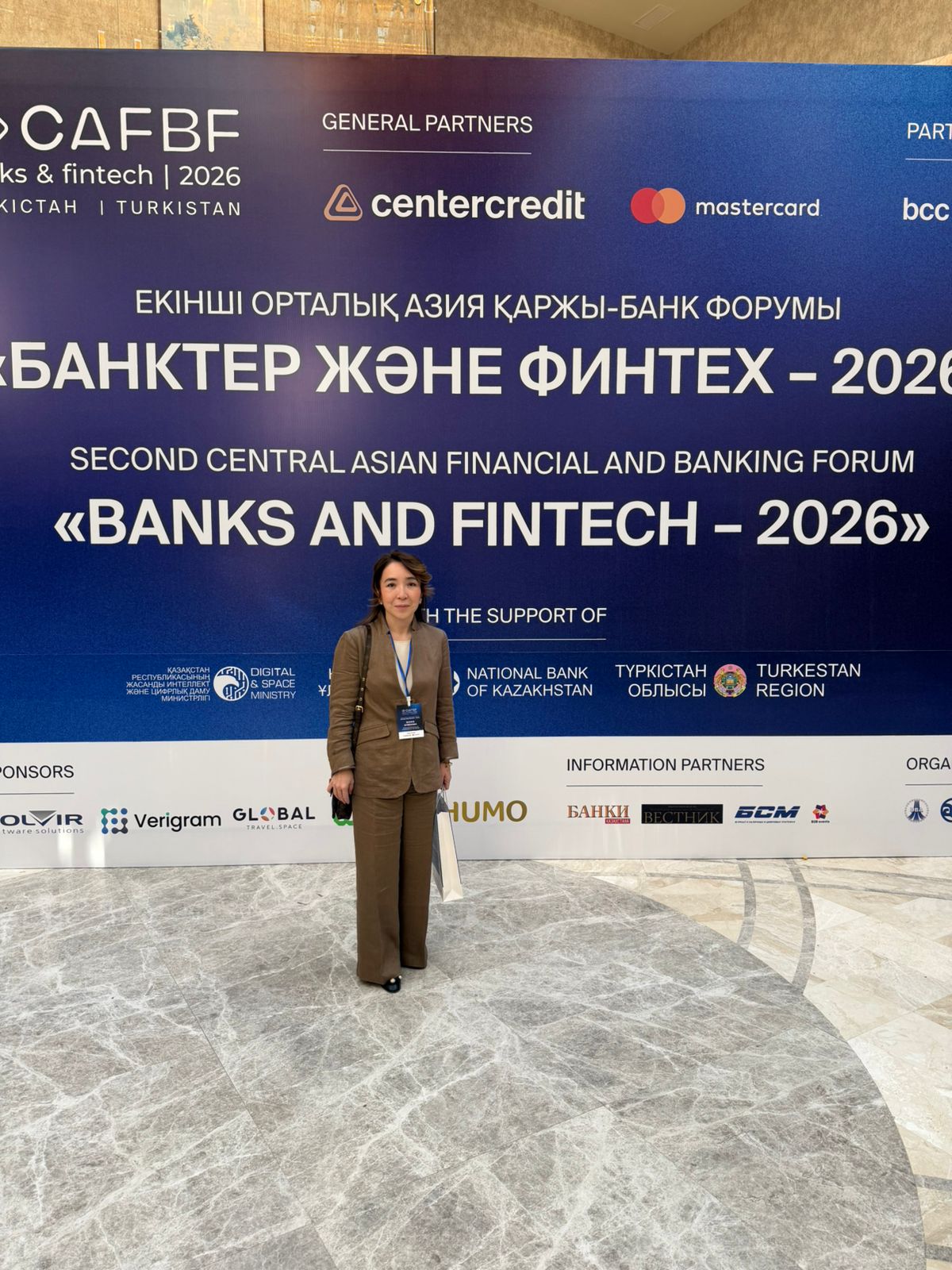
On April 24, 2026, the II Central Asian Financial and Banking Forum “Banks and FinTech – Turkistan 2026” was held in the city of Turkistan, bringing together representatives of government bodies, financial institutions, international organizations, and the expert community.
The forum was attended by Zhanna Yermekova, Dean of the Higher School of Economics and Business at Al-Farabi Kazakh National University, as well as Rustem Utegulov, Director of the Center for Economic Research.

During plenary sessions and thematic panel discussions, key trends in the transformation of the financial sector were examined, including the development of financial technologies, digitalization of the banking system, implementation of artificial intelligence, and the formation of modern financial ecosystems in Central Asia. Particular attention was paid to regional financial integration, open banking, the digital tenge, and cybersecurity.
Sessions dedicated to sustainable development and the ESG agenda attracted significant attention. This area represents one of the strategic priorities of the Higher School of Economics and Business, within which research and grant projects in ESG and green finance are actively implemented. The university consistently integrates sustainable development principles into its academic and research activities. This is evidenced by the opening of a specialized classroom designed for 40 students and focused on developing ESG-related competencies.
Special emphasis was also placed on Islamic finance. The Higher School of Economics and Business plays an active role in advancing this field amid the transformation of the national financial system. In line with the initiatives of the Head of State, opportunities for integrating Islamic finance instruments into the operations of second-tier banks are expanding.
In this regard, in cooperation with the Association of Islamic Finance and Business of Kazakhstan, the launch of micro-qualification programs in Islamic finance has been initiated. These programs are designed for a wide audience, including professionals in the financial sector and other interested stakeholders.
The forum also facilitated the establishment and strengthening of partnerships with representatives of the financial sector, including Eurasian Bank, Alif Bank, and Altyn Bank, as well as business representatives. The agreements reached are aimed at developing strategic partnerships, expanding opportunities for professional internships, and introducing elements of dual education.
In addition, professional contacts were established with Shaul David, an international expert in financial technologies, a consultant in Embedded Finance and digital payments, and a lecturer at Dublin University.

During the plenary session, Shaul David delivered a keynote speech titled “The Invisible Engine: Banking in the Age of Embedded Finance and Agentic AI,” presenting conceptual approaches to the evolution of the banking industry in the context of embedded finance and artificial intelligence integration. As a result of the discussions, agreements were reached on developing academic cooperation and providing specialized scientific literature to the university.
Participation in the forum reflects the university’s strategic mission as a leading higher education institution contributing to the development of the country’s intellectual and human capital. In the context of rapid financial market transformation, the integration of advanced international practices into the educational process, strengthening collaboration with industry, and training competitive next-generation specialists are of particular importance.
Other news


